MUTATED NON EURORACK
SHROOTHY (desktop monosynth)
SHROOTHY (desktop monosynth)
Couldn't load pickup availability
Shroothy, a digital/analog hybrid MIDI monosynth.

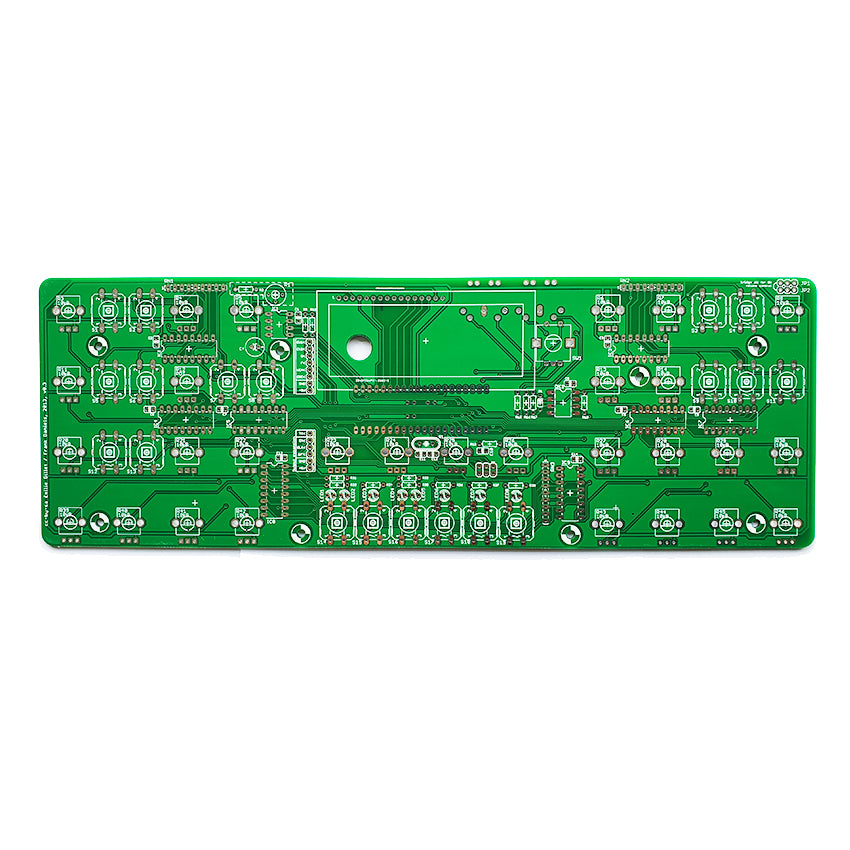
This project is a redesign of the original Shruti-1, with a spec'ed up CPU,
and a focus on easy upgrades/modification of the analog section.
The ATMega644p allows new features in the firmware -- a larger selection of
oscillator algorithms, a bigger selection of wavetables, and a tiny sequencer.

Original developer: Emilie Gillet (emilie.o.gillet@gmail.com)

The firmware is released under a GPL3.0 license. It includes a
reimplementation of the formant synthesis algorithm used in Peter Knight's
Cantarino speech synthesizer.

The PCB layouts and schematics (in /hardware/shruthi/design/pcb)
are released under a Creative Commons cc-by-sa 3.0 license - except for some
discontinued filter boards which were released under a cc-by-nc-sa 3.0 license.

Documentation, analyses, simulations and 3D models are released under a
Creative Commons cc-by-sa 3.0 license.
Build info /options
XT Expanded main board (you don't need the small main board if you get this)
Flying Kick (Sidekick)
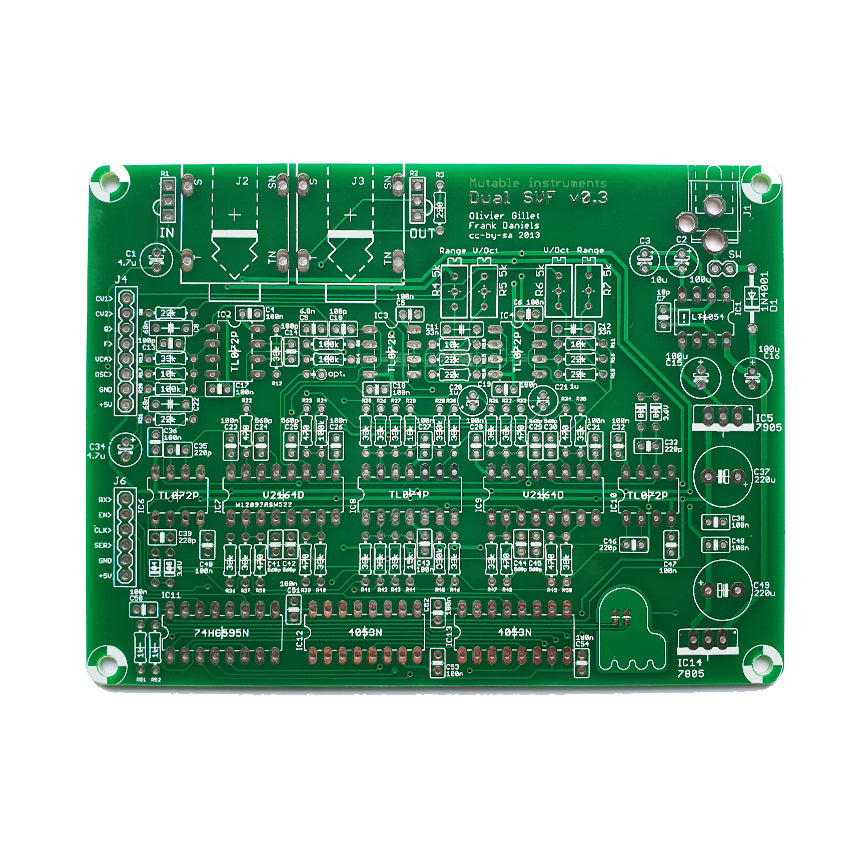
The Flying kick is a simple circuit, of dimensions similar to those of the Shruthi-1 digital board, which allows you to drive one of the Shruthi-1 filters without all the hassles of MIDI, menus, and modulation matrices. Pick your favorite filter board, snap the Sidekick on top of it, plug in an external audio source (or not) and get ready for some filtering action!
The Flying kick comprises 2 square/triangle LFOs and 2 AR envelopes, which are assigned to the VCF frequency and the VCA gain. The LFOs can oscillate at audio rates, allowing them to be used as droning oscillators, a FM source or ring-modulators. The envelopes are triggered by a dedicated button.

From top to bottom, left to right, the knobs are:
- Filter cutoff.
- AR envelope 1 filter modulation amount.
- LFO1 filter modulation amount.
- Filter resonance.
- AR envelope 2 VCA modulation amount. When turned counter-clockwise, the gain is at a flat 50%. When turned clockwise, the gain matches the AR envelope 2 value.
- LFO2 VCA modulation amount.
- LFO1 rate.
- AR envelope 1 attack speed.
- AR envelope 1 release speed.
- LFO2 rate.
- AR envelope 2 attack speed.
- AR envelope 2 release speed.
The two WF switches are used to switch the waveform (square or triangle) of the LFO 1 and 2 respectively.
The 4 tact switches have the following function, from left to right:
- Temporarily routes LFO1 to the audio input of the filter (allows LFO1 to be heard as an oscillator).
- Temporarily routes LFO2 to the audio input of the filter (allows LFO2 to be heard as an oscillator).
- Triggers AR envelope 1.
- Triggers AR envelope 2.
Hacking is fun, here are some cool hackey things you can do with the Sidekick:
- Solder a pin header and add a jumper at the pads labelled “Drone lock” to constantly route the LFOs to the audio input of the filter.
- Connect a jack and a sustain pedal to the pads marked Kicks and Kinks to trigger the AR envelopes with your cat feet.
- Use F/F breadboard jumper wires to rewire the mapping of the CV signals to cutoff/frequency/VCA/CV1/CV2 in the Smurf modular mini patch zone. Because we all know you want to hardwire the resonance to +5V.